There are times when, as the writer for an organ procurement organization, I feel particularly moved by a person’s story. Often the tears don’t fall until the camera is off and I’m blindly staring out the window, hearing the voices of my family echo downstairs and feeling a deep sense of gratitude that they are still here. I hear from donor family members who have lost and organ/tissue recipients who have gained, and after every conversation I walk away a different person.
In early December, I conducted a different kind of interview — one about living donation. HonorBridge deals solely with donation after death, but there is a way for people to save a life while they’re still living, that story needs to be told.
David Krissman is an award-winning writer, producer, editor, and creative director, though he’ll tell you he’s simply a storyteller at heart. In high school, his dream was to write for Hollywood. After earning his undergraduate degree, he launched his career in journalism, ready to chase those dreams. But life, as it often does, dealt him a card he did not see coming.
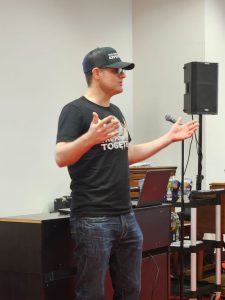
“When I was about 25, I started to not feel well,” said David. “I had symptoms similar to long COVID, and I could barely keep my job down. My dad used to take me on small walks up and down the street so I could get exercise, but when I would overdo it, it would set me back like two weeks. After about a year and a half of basically being debilitated, I was given medication to try off-label — it’s something that they’re using to treat long COVID today. It gave me my life back. I was able to start running again and I was able to get my master’s degree in film production. I worked in the entertainment business for about ten years after I graduated, but I never forgot what it felt like to be sick.”
As they say, sympathy is feeling for someone, but empathy is feeling with someone–and David’s empathy was a powerful thing. After stumbling across a New York Times article about kidney failure and paired exchange, he immediately saw the potential for a compelling film. But once he began speaking with doctors, researchers, economists, patients, donors, and people on dialysis, he realized there was a much larger story to be told.
“I had fallen in love with this patient population and I knew there was a better way to help them,” said David. “I produced this podcast documentary series called The Great Social Experiment, which is the story and lessons of our country’s only experiment with universal healthcare. Since 1972, the US government has guaranteed healthcare coverage for people with kidney failure. While this system has been a liferaft for people who need dialysis, we can do a much better job of getting people to transplant.”
After producing the podcast, David focused on building resources for the website to educate people facing kidney failure and empower them to advocate for a kidney. These included free, easy-to-create microsites where patients could share their stories, a free video series explaining how to search for a living donor, and clear information about transplant programs and the National Kidney Registry. But, in time, David realized there was more to be done.
“For the longest time, we’ve been trying to teach people how to get their story out there, like teaching someone how to fish,” said David. “But the thing that I realized is that it doesn’t really pay to teach someone to fish if they can’t lift a fishing pole. And that is exactly what we’re dealing with. These people are just trying to make it to the next day. They often don’t have energy, they feel sick, and they are utterly depressed. And even if they weren’t, most people don’t have that skillset. Yet, we expect them to do this all on their own. So, I thought, what if we just do it for them?”
David began serving as a strong patient partner on a pro bono basis, starting with a small group of patients he found through his own research and in Facebook support communities. His role included organizing their campaigns, producing media, and mobilizing each patient’s community. After helping several patients, he gathered data, built a presentation, and began reaching out to surgical directors across the country — including Dr. David Leeser at ECU Health.
“Dr. Leeser said, ‘Let’s do it!’” recalled David. “ECU had a grant to fund patients, but I was then introduced to HonorBridge CEO, Danielle Bumarch. I remember pitching to her and asking for her help in sponsoring another patient, and she said yes, which I’m eternally grateful for. HonorBridge doesn’t make any money from living donation, yet you guys still said yes. I think that speaks volumes about Danielle and everyone who works for her.”
The program follows a clear structure. When onboarding a patient, the team helps them adopt a different mindset about seeking a kidney. They begin by sitting the patient down to record a video and preparing content for their eventual campaign. In addition to this, they organize an in-person event, understanding that most people won’t share a patient’s story unless they truly understand what’s happening.
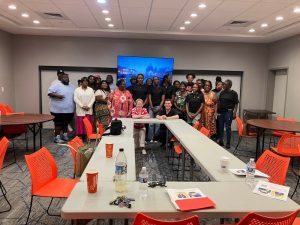
“Even though kidney failure has a lower life expectancy than most cancers, most people don’t even know what the kidneys do,” said David. “So, before we launch their campaign, we throw an in-person event for each patient and educate their friends and family. We bring food and play the patient’s video that we created. We go over how we share the media and what they should expect. They get a crash course in living donation, transplantation, and dialysis. Shortly after that, we take the video and we throw it up on social media and they all start sharing.”
David recognized that not every patient has a large community to share their video on their behalf, so he created something called Angel Advocates, a crowdsharing program that gives people who don’t know these patients the ability to help amplify their voice and save a life. While not everyone is able to donate a kidney, anyone can help by sharing a patient’s story on social media.
“These are people who don’t know the patient, but who say, ‘hey, you’re going to send me one email a week and all I have to do is share it on social media? Easy peasy,’” said David.
Remarkably, the same patient that was sponsored by HonorBridge, Jalesa, was saved by her own angel advocate, HonorBridge employee Stephanie Wiggins.
“In the case with Stephanie, it was the craziest thing,” said David. “It was somebody at HonorBridge who saw the post and decided to be an angel advocate. Eventually, she went and got evaluated. She wasn’t a match, but she got Jalesa a voucher with the National Kidney Registry, and Jalesa got her kidney.”
While searching for an angel advocate for a patient named Meyrick, David connected with a professor at ECU’s School of Nursing, who invited him to present the angel advocate idea to her students.
“I was still having problems getting people to come in and get evaluated for Meyrick, so I personally went all around town in Los Angeles wearing a sandwich board that read, ‘My friend Meyrick needs a kidney,’ with a QR code that linked directly back to his webpage,” recalled David. “I probably went out seven times for him, but ultimately, it was that same nursing professor who ended up giving him a voucher with the National Kidney Registry. About two months later, he got a kidney.”

While the project first began at ECU in 2024, David is now working with three transplant centers in Pennsylvania, funded by Gift of Life, one of the state’s organ procurement organizations.
“I’d love to scale it up at ECU and in Pennsylvania,” said David. “I think it’s a no brainer, to be honest. When someone has a living donor, the hospital makes money, the patient has a better outcome, and the taxpayer saves money. And private insurance saves a tremendous amount. Everyone has an incentive to do this, and very rarely in healthcare do you see all of those financial incentives align so nicely.”
Despite a laundry list of accomplishments in the world of journalism and film, David says that The Great Social Experiment is by far the “coolest thing” he’s ever done.
“When I graduated film school, if you had asked me whether I would be able to help save someone’s life through storytelling, I would tell you you’re crazy,” said David, grinning. “I never imagined that there would be a way to use my skillset with such a direct impact. My thesis film played at festivals, and I always thought the very best feeling you could get, professionally, was to sit in a theater and watch an audience exude emotion over something that you wrote and created. I used to think that was the coolest, best feeling in the world. Until this.”
Despite his success, David is quick to remind everyone that the real heroes are the people who are willing to undergo surgery simply to help someone else.
“These people are willing to go under the knife to help somebody in need, sometimes a complete stranger, with nothing in return other than the benefit to their own heart,” said David. “It’s amazing. It shows you the very best of humanity. If it weren’t for the donors, it wouldn’t matter if I put out an Academy Award-winning short film for every single patient. They’re the ones who make this possible.”
David also believes that the “best of humanity” can be seen in donor families who choose donation for their loved ones at their darkest, most vulnerable moments. While living donation is his main focus, he makes sure that everyone understands how many lives can be saved by simply signing up to be a donor after death.
“It’s important to talk to these patients and their communities about donation after death, because not all of them are going to find a living donor,” said David. “If you’re not a registered organ donor, you should be. There are people waiting, and so many lives can be saved.”
To learn more about The Great Social Experiment and how to become an Angel Advocate, click here!