
For Dr. Andrew Barbas, transplant surgery is where his love for problem-solving, cutting-edge medicine, and making a real difference in people’s lives all come together.
“I started out in engineering at Duke,” he said. “But over time, I realized I wanted to work with patients, and it led me into medicine. I found that, after I got into medical school, surgery kind of appealed to the engineering mindset that I had. You’re trying to fix specific problems and do it quickly.”
During his residency, Dr. Barbas got exposed to transplant surgery and saw how dramatic an impact it had on people’s lives. Since joining Duke’s faculty in 2016, Dr. Barbas has been deeply involved in advancing transplant care, performing liver, kidney, pancreas, and even pediatric transplants.
“I love clinical care, I love the procedures, I love taking care of the patients,” he said. “I also love how transplant is a relatively new field, compared to other sub-specialties in surgery. There’s new innovation and new technology that’s constantly coming into transplant. We’re always trying to find new and better ways to do things.”
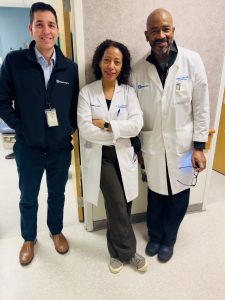
Thanks to innovations like machine perfusion and Normothermic Regional Perfusion (NRP)—a method that temporarily restores blood flow to certain organs in the donor’s body—organs that used to be considered too risky because of donor age, medical history, or other factors are now being used to save lives.
“Trying every time is such an important thing, especially as we come to utilize these new technologies like machine perfusion,” said Dr. Barbas. “With new technologies, great transplantable livers can come from donors with a complex clinical or medical history. We have a much wider potential than we had even five years ago. A few years back, if you’d asked me whether we could transplant a liver from a 70-year-old DCD donor, I would’ve questioned it. But we’ve now had good experiences with those donors, especially when you pair them with NRP. We’ve used two 87-year-old livers and an 86-year-old liver through machine perfusion technology with great outcomes.”
Technology is also making distance less of a limiting factor. Dr. Barbas shared how machine perfusion allowed Duke to transplant a liver from as far away as Saskatchewan, Canada, and Portland, Oregon.
“Geographically there’s no real limits anymore, because we can transplant livers from across the country if we need to,” he said. “It’s all going to benefit the patients on the waiting list.”
Dr. Barbas, who performed the very first recovery in HonorBridge’s Donor Care Center in early 2024, applauds the organization’s willingness to try new technologies in an effort to push transplant forward.
“I’ve really loved working with HonorBridge,” said Dr. Barbas. “I think it’s a really dedicated group of folks. There have been a ton of changes and advancements along the way. It’s really neat to see some of the milestones, like the Donor Care Center opening and the NRP program starting. These are really big steps forward.”
Working in this field means facing the difficult reality that not every organ can be successfully transplanted. This truth can be a tough blow for HonorBridge team members, who work hard to save as many lives as possible. Dr. Barbas remains hopeful that advancements in technology will reduce the frequency of these outcomes but reminds staff that none of their efforts are in vain.
“I think without the efforts and the attempt in the first place, none of this would be possible for the whole system,” he said.
As transplantation continues to evolve, Dr. Barbas never loses sight of what truly makes this all possible—the donors and their families.
“To the donor families, we’re just extremely grateful for what you’ve done,” he said. “Transplant is, by its nature, a bittersweet endeavor. Someone’s passing has allowed the act to occur in the first place. As a transplant surgeon, I can’t tell you how grateful we are to be able to take care of your loved ones and allow their gift to be taken forward.”