For many people in their twenties, an annual checkup can feel more like a box to check than an important part of staying healthy. Between searching for a first job, starting a career, and adjusting to life with full-time benefits, making time for a doctor’s appointment can easily fall to the bottom of the list.
For Phelicia, who had recently started a full-time position at East Carolina University, scheduling a checkup seemed like a simple, uneventful step. She never expected a routine appointment to uncover something that would change the course of her life.
“I got a phone call that my numbers looked a little funny, and she’d like me to have a biopsy,” recalled Phelicia. “At the time, I had no idea what creatinine was. It might as well have been a foreign language.”
The biopsy was performed over Christmas break, and on December 30, Phelicia received a call from her doctor with news that her kidneys were functioning at just 21%.
“I know they call most heart problems ‘silent killers,’ but I feel like kidney issues could be right underneath that because I had no symptoms,” said Phelicia.
Phelicia began dialysis after learning that a friend who had offered to donate a kidney was not a match.
“We hoped I’d be transplanted before I had to go on dialysis,” said Phelicia. “But when we found out he wasn’t a match, I had to start to keep my body healthy enough for a transplant. Luckily for me, it was only three months.”
Although her time on dialysis was relatively short, Phelicia says the experience was anything but easy.
“If I’m honest, I think that’s when everything shifted for me,” she said. “My personality, my age at the time … I just did not do well, and there’s no way to sugarcoat that. At my dialysis center, it seemed like everyone had given up. Whereas I, if I had been a cartoon, I would have been kicking and screaming at every turn. I was like, this is not living.”
On May 5, 2016, Phelicia received a lifesaving kidney from her cousin, who was a perfect match. Recovery went well, and she was finally free from the shackles of dialysis. But as she soon discovered, receiving a transplant didn’t mean every challenge was behind her.
“Once I hit the three-month post-transplant mark, the doctor said that a lot of transplant patients gain about 30 pounds,” said Phelicia. “I remember thinking that wouldn’t be me, because I’m naturally a slim person. But, when I was suddenly able to eat all the foods that I hadn’t eaten since 2010, I started eating them like I was getting a stipend!”
Knowing she needed to make a change, Phelicia started looking for a way to get moving again. She found her starting point in a yoga class at the wellness center attached to the hospital.
“I think I went into it thinking, this is probably something I can start slow and work my way up. I probably shouldn’t go from a transplant to a marathon. So let me start here.”
After a year of taking yoga classes, Phelicia was asked if she’d be interested in training to become a certified yoga instructor herself. She immediately jumped at the opportunity.
“I thought, how nice would it be to make money doing something I really enjoyed?” She said.
Today, Phelicia is an economics professor and a registered yoga teacher who uses her wellness and yoga background to support transplant recovery and health education.

“After transplant, many people assume that your life is saved and everything is hunky-dory,” said Phelicia. “But that’s not always the case. My hair thinned out, I had really bad acne, and then there were the mental aspects of medication. Sometimes you miss your old self and your old life. With yoga, I found a way of moving my emotions through my body.”
In 2017, Phelicia learned about the Transplant Games of America at a transplant support group. She began attending the meetings, and the following year, she traveled to Salt Lake City to participate in the Games.
“I actually did a wellness workshop at the Transplant Games that year,” Phelicia said. “I was excited because I was fresh off of yoga teacher training, and I wanted to share all the things.”
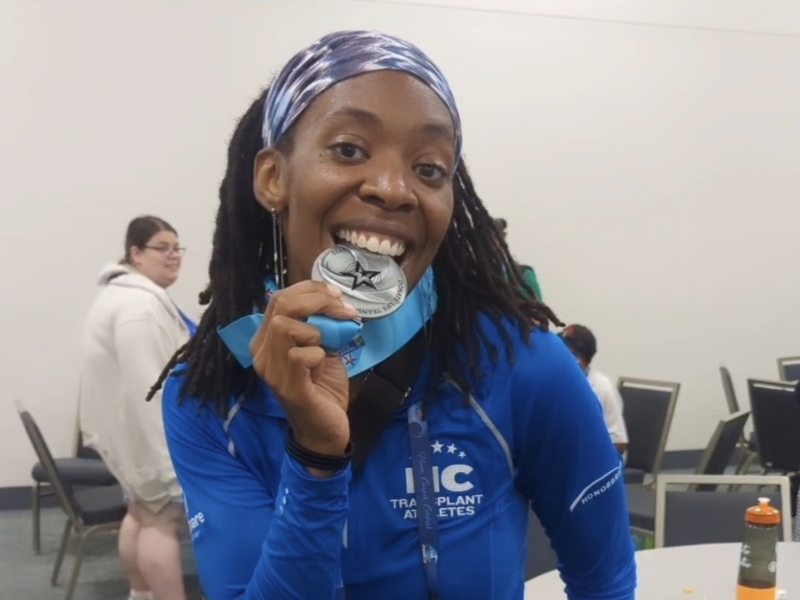
That passion for wellness has continued to grow. At this year’s Games in Denver, Phelicia returned as an instructor, teaching two yoga classes for fellow transplant recipients. But for Phelicia, the Games are about much more than the opportunity to teach yoga. Since she first attended, they have given her a sense of camaraderie and connection that she hasn’t found anywhere else.
“It’s definitely a special group,” said Phelicia. “It benefits you to have a group of people who know what you’re going through. It’s encouraging to meet people who have had their kidneys for 30, 40 years. That’s what’s fueling me.”
Phelicia says some of her closest friendships have come through the Games. Laura Smith, who was the manager and president of the North Carolina transplant team when Phelicia first joined, quickly became one of those friends. Sadly, Laura passed away this year, but the friendship the two shared was filled with wonderful memories. They were trivia buddies, shared a birthday, and affectionately referred to themselves as “sisters from another mister.”

“I think of Laura, Darryl, and Yvette, all of whom I met when I first started,” said Phelicia. “And this year, I met 30 new participants and got to know this whole new family of people. The camaraderie is like nothing else. Our team won the Spirit Award at the Games this year for a reason!”
Phelicia encourages every transplant recipient to consider participating in the Games, regardless of their athletic background.
“For some participants who were high school or college athletes, this is another opportunity to shine,” she said. “But for me, I was much more of an artsy kid. I haven’t bounced a ball, I don’t know how to throw a ball. I don’t do any of that. But we have trivia at the Games, and that’s my event. I take it seriously!”
For Phelicia, one particular moment from the Games has stayed with her, and it had nothing to do with winning a medal in trivia.
“It was at my very first Games in Salt Lake City,” she said. “They had us march onto a baseball field, and then we lined up in the stands. After all 50 states have been introduced, the donor families walk in holding quilts, signs, and pictures. We’re standing, and we’re applauding. People were beside themselves with emotion. They do it every year, but the first time you see it for yourself, there’s no way you’re going to forget it.”
Although Phelicia received a kidney from a living donor, the Games have given her a deep appreciation for donation after death. Many of her teammates’ lives have been saved because someone made the selfless decision to say “yes” to donation, and that isn’t lost on her.
“A thank you is not even enough,” said Phelicia. “To honor what your loved one wanted, even when they’re no longer here, is one of the most beautiful things you can do. If I could say anything to them, I would say thank you for allowing someone else to open their eyes and see another sunrise.”
Interested in joining the team? Click here to learn more!