Most people will never meet someone whose job is to recover organs for transplant, but for Jonathan “JT” Neff, it’s part of everyday life.
“Organ recovery can be a very sad place to be, but it’s also a bridge to something that is very positive,” said JT. “Every case carries meaning. I go into the operating room following a tragedy, fully knowing that someone across the country is hoping for a call that can save their life. The way I always describe it is, ‘you’re like the bridge between two stories.’”
As a certified physician assistant (PA-C), JT works at HonorBridge as a Surgical Organ Recovery Specialist. His job includes recovering organs, primarily kidneys and livers, so they can be transplanted into patients who need them. He is also often responsible for cannulation during HonorBridge-led NRP (Normothermic Regional Perfusion) cases. In simple terms, cannulation is the process of inserting small tubes into the main blood vessels so that blood can be safely pumped through the organs. NRP itself is a procedure that connects the main blood vessels of the body to a machine that circulates blood through only abdominal organs after death has been declared. HonorBridge’s NRP program follows some of the most stringent safety and ethical protocols in transplantation to ensure the process is carried out with the utmost care and respect for the donor. Overall, NRP gives these organs a better chance for a successful transplant into the recipient.
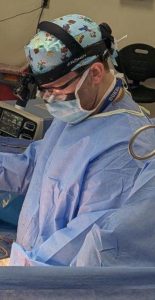
JT’s career path took several unexpected turns before leading him to medicine (fun fact: he was once an amateur hockey player). After returning to college to study exercise and sports science, he developed a fascination with anatomy. While obtaining his undergraduate degree, he became an EMT working on an ambulance, gaining his first real hands-on experience in healthcare. After graduating, he joined the critical care transport team at Duke Life Flight, where caring for critically ill patients inspired him to pursue PA school.
After earning his PA degree, he completed a surgical PA residency at Duke University Hospital. During this rigorous training, he worked closely with the Duke transplant team, where he was introduced to transplant surgery, the organ procurement process, and HonorBridge.
“I’ve been working for HonorBridge since November 2023,” he said. “When I first arrived, we were working on getting the Donor Care Unit (DCU) ready for its first case, which happened in early 2024. Working in our DCU is very different from working in a hospital operating room. The best way I can describe it is having home field advantage. Everybody knows all parts of the case and what’s going to happen next. It’s like all cylinders are firing and we’re a well-oiled machine. On top of all of that, everyone in the DCU understands the goal and the weight of being stewards of the gift.”
For JT, being a “steward of the gift” isn’t just a professional responsibility. Having recently become a father, organ donation represents a future where his daughter can create memories with her grandfather.

“My father will need a kidney transplant in the future,” he said. “I became aware of this years ago, and it’s what drew me to transplant as a whole. I likely won’t recover the kidneys
that he’s going to get, but my work at HonorBridge makes me feel like I’m helping other families out there who are in the same position that we’re in. Donations save lives, whether it’s a brother, a sister, or in my case, a father.”

For JT, “honoring the gift” in the operating room means recognizing the amount of trust a patient places in the surgical team.
“I want people to understand that recovering organs is not a transactional procedure,” he said. “It’s a deep human experience involving sacrifice, vulnerability, and the family or patient’s generosity. We’re not just going in there with our minds set on organs. We feel for the patients and families, and we understand what’s going on. The fact that they’re able to agree to something like this amidst their loss is so powerful. We approach all families with gratitude, and I hope they understand that we carry out all of our recoveries with great dignity.”
JT urges the public to see organ, eye, and tissue donation as a powerful way to save lives and encourages people not to let myths or misconceptions prevent them from becoming an organ donor.
“The hospital team cares for the patient, and the recovery team works separately,” he said. “We never move forward until all lifesaving therapies are exhausted and the hospital team has officially declared death. It’s important to remember that behind every transplant, there’s someone waiting across the country whose life could be saved. Signing up as a donor is one of the most meaningful ways to make a difference.”
75 or more lives can be saved and healed by one organ, eye, and tissue donor. Sign up today!