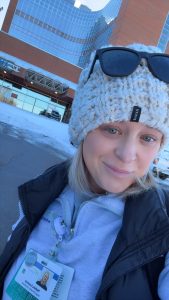
This winter, a snowstorm swept across parts of North Carolina, leaving widespread power outages, subfreezing temperatures, and dangerously icy roads in its wake. In some areas, snowfall topped 19 inches. In Cabarrus County, a series of crashes on I-85 North left more than 100 vehicles stranded, just miles from the home of Melisha Goenner.
“We got a little over 15 inches,” recalled Melisha. “I went to open my back door on Sunday morning, and there was so much snow that my door pushed the snow away from the house.”
While that much snow kept most North Carolinians confined to their homes, Melisha—an organ donation coordinator (ODC) with HonorBridge—didn’t see staying put as an option. In the organ donation world, ODCs travel to hospitals across the state to serve as the clinical eyes and ears for potential donors, closely monitoring their status and working to optimize each gift of life. That morning, a potential donor was at a NC hospital. She was the only one from HonorBridge who could get there.

“Before HonorBridge, I worked for 25 years in emergency medicine,” said Melisha. “We never had a choice but to show up, so that was my mentality. I packed a bag, because if I made it there, I was prepared to stay there. I got in my Subaru and hit the road. I-85 was a complete ice rink, and there was no traction at all—I was probably going 25 miles per hour the entire time.”
When she arrived, the donor’s grandmother was there too, holding onto hope that organ donation would still be possible. On a typical day, HonorBridge would send a family support coordinator (FSC) to be with the family, but the FSC on call couldn’t safely make it in. That day, Melisha stepped into the role herself. She sat beside the grandmother, gently brushing the donor’s hair and bending a paper clip into a makeshift bobby pin because it was all they had.
“The grandmother was so worried that we weren’t going to be able to do the organ procurement,” said Melisha. “She said, “If this doesn’t work out, it’s going to break my heart all over again.’ That was all she had to say to me. If I had to drive across the state, I was going to. If I had to spend the next 24 hours camping down in the hospital, I would. I was going to do everything in my power to make sure that this happened, because she needed something positive to hold onto.”
Unfortunately, the curveballs the day would throw at them had only just begun. For organ recovery to be possible, the donor would have to be flown to Duke, a challenging feat in the middle of a winter storm. Incredibly, a flight crew was available to make the trip, but they needed to refuel, and the local airport was closed. Luckily, they were able to fuel up at Charlotte Douglas.”
Melisha told the grandmother that the helicopter was on its way, but the helipad had to be cleared of all ice and snow to make a safe landing. The nursing supervisor and hospital security were understandably nervous, but Melisha went to the pad herself to put their minds at ease.
“I told them, if the flight crew didn’t feel safe, they wouldn’t come,” said Melisha. “I went up and had a look, and it was clear. They had salted it, shoveled it, and it looked pristine. When the crew from Duke Life Flight arrived, I thanked them for showing up in such bad weather. They said, ‘absolutely, this is super important to us.’ They were so nice.”
When it came time for the Honor Walk, family members, hospital staff, and the flight crew (including the pilot) all lined the halls.
“I don’t know how our FSCs do it, because I opened my mouth and only got a couple of words in before I was crying,” said Melisha. “Everybody was crying, including the crew. It was very powerful.”
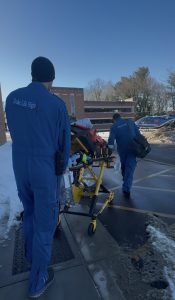
Because the icy conditions made it unsafe for the grandmother to walk to the helicopter pad, Melisha went in her place, taking photos and video as the donor left the hospital. When they were safely in the air and on their way to Duke, Melisha climbed back into her Subaru to head to Winston-Salem—another risk she was willing to take.
“When I was doing the donor’s hair, I got a message saying that we needed to get a lab sample to the VRL Diagnostics Lab in Winston Salem by 4 p.m. to test for infectious disease,” said Melisha. “This had to be completed before the organs could be transplanted, but there was no airspace courier available. Nobody was coming out.”
Melisha had made a promise to the donor’s grandmother that she would do everything in her power to make donation possible, and it was a promise she intended to keep.
“I called my son, who lives in Winston-Salem, and asked him how the roads were,” she recalled. “He said, ‘The roads are bad, are you sure you can make it?’ I said, ‘I don’t know if I can make it, but I promised this grandma that I’d do whatever I needed to do to make this happen. If that means me driving a sample to Winston-Salem, then that’s what I’m going to do.”
Incredibly, Melisha got the sample to the lab by 4 p.m., and the donor safely made it to Duke. Despite not being on the schedule, Meg Whitaker, an HonorBridge ODC III based in Chapel Hill, volunteered to meet the donor onsite and stayed in the operating room until 4 a.m., keeping Melisha updated via text the entire time.
“That weekend was hard,” recalled Meg. “Not just ‘busy’ hard, but also heavy hard. Weather, snowstorms, delays, constant pivots, and moments where it genuinely felt like it might not happen at all. But what stood out the most was the humanity … people refused to quit. Plans were rebuilt over and over. Extra hours were worked, and extra miles were driven and flown. Time, comfort, and convenience were sacrificed so that organ donation could be honored.”
As Meg said, this particular case took all they had—but in the end, it mattered more than ever. Five people’s lives were saved across the United States, including the lives of two children.
“When I got home, I cried like a baby,” said Melisha. “I am so grateful for the process, and I was so grateful for the whole team. Duke Life Flight had 15 calls on the ground truck backed up and waiting to be run, but they made us a priority that day. Meg didn’t have to go onsite to receive the patient, but she volunteered to do it. I have so much gratitude for all of them. If we had not busted our behinds to do what we all did, that grandma’s heart would have been broken all over again.”
Melisha says that, despite the risks she took that day, it was an honor to be trusted with something so precious.
“Being an emergency room nurse for over 20 years, I always felt like I saved lives,” said Melisha. “But until I started as an ODC at HonorBridge, I didn’t know what saving lives truly meant. Now I do.”