Stan Williams has spent his life bringing people together. As an active lobbyist for the North Carolina Symphony, a loving father, grandfather, and friend, Stan has built a network of lasting relationships over the years.
“I was an only child and I hated it. So, consequently, I now have a lot of friends,” says Stan, a wide grin on his face. “I have a great network, but I’m the glue. I’m the one that keeps us all together.”
Now, at 75, he’s relying on that same circle of support as he faces one of the great challenges of his life: finding a kidney donor.
For nearly two decades, Stan Williams has been living with polycystic kidney disease (PKD), a condition that impacts kidney function and can become life-threatening over time. The only cure? A kidney transplant.
“I was officially diagnosed at the age of 56,” said Stan. “The wonderful thing is that I did not have the primary symptom for the disease, high blood pressure. I don’t have kidney stones, I don’t have swelling, I just have a big stomach full of cysts that I’m a bit self-conscious of. I have been very fortunate, but all of this could change tomorrow.”
Stan has handled the disease with diet, exercise, and a great sense of humor, but he’s also realistic. After years of being considered “too healthy” to receive a transplant, Stan’s kidney function has recently declined. After extensive evaluations and screenings at the UNC Kidney Center in Chapel Hill, he is now eligible to receive a kidney and is hoping to soon be “activated” on the transplant list. But there’s a catch: the wait is long, and the need far exceeds the supply. That’s why he’s turned to his community for help.
Following the advice of his good friend, NC Chancellor Kevin Howell, who received a kidney transplant 12 years ago, Stan wrote a letter explaining his situation. Several friends signed it and shared it with their own networks, asking people to consider becoming a living kidney donor for Stan.
“I never ask anyone directly for a kidney,” Stan explains. “I just ask them to share my story.”
So far, seven people have stepped forward to be tested as potential donors, with many others continuing to pass his letter along.
For Stan, a living donor is particularly important. Because PKD is hereditary, his children are not able to be considered. Until his name is officially activated on the transplant list, friends and community members remain his only hope for a second chance at life.
“Not everyone has the opportunity to give the gift of life,” he says. “For me, a new kidney would mean just that. Even though I’m 75, I don’t act my age. Other than this disease, I’m as healthy as a horse. I don’t want this to be the cause of my demise. I have a lot more to contribute. With a transplant, I’ll be able to keep doing the things I love.”
Those things include his work with the NC Symphony, which he describes as “a joy” and something he has no intention of giving up.
“As long as my energy level and mental acuity are good, why should I retire from something I love?” he says.
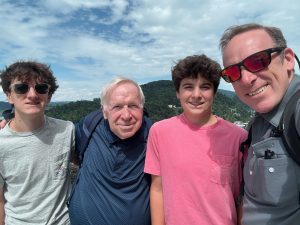
But more than anything, Stan wants to be there for his family. His son, now 48, also has PKD, though so far without major complications. His daughter, 45, tested negative. Stan says his children have been a great source of support, particularly after the loss of his wife.
“They’re very concerned about me because their mom died in 2014,” he says. “They were too young to lose a mom. Naturally, their attention turned to me, because I’m their only living parent. If I need something, they’ll be right there, and vice versa.”
His three grandchildren, including a 3-year-old grandson he helps care for weekly, are his greatest motivation.
“My son has fraternal twin boys who are now 15, and my daughter has a 3 ½ year old boy,” says Stan. “I just want to live long enough to see my grandsons graduate from college, maybe get married, and see the youngest graduate from high school,” he says. “That’s all I want, and I’ll be very happy.”
While Stan often feels like asking someone to consider being a living donor is “intrusive,” he also knows the power of generosity. His late wife, Kathryn, was a cornea donor.
“When you can help a person, especially in a life-changing way, you can’t do anything better than that,” said Stan. “I would encourage people, if they’re not already a donor, to become one. My wife had the heart on her driver’s license, so when she passed, I knew it’s what she wanted. I’ve never met the person who received her eyes, but I would love to. No matter how hard it may be, it’s the right thing to do.”
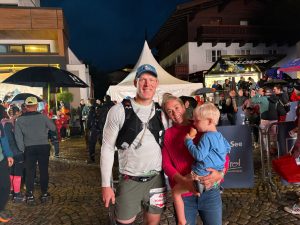
Today, Stan is holding on to the possibility that someone, somewhere, will step forward to give him a second chance.
“My plea is simple: I want to live,” he says. “When you’re looking for a kidney, it’s nonpartisan. You’ll take a kidney from anyone. I might be 75, but my nephrologist said that I’m younger than a number of 50 year olds! I have taken good care of myself, and I want to sustain my life so I can spend time with my family. I can’t live forever, and I don’t want to, but I don’t want to miss out on seeing them grow.”
If you are interested in learning more about becoming a living donor for Stan, or simply want more information about the process, please reach out to:
Kristen Martin
Living Donor Coordinator
UNC Kidney Center, Chapel Hill
📞 984-974-7568
If you contact Kristen, please mention that you are “calling on behalf of Ray Stanford Williams, Jr. (Stan), who is on the UNC Kidney Center’s list for a transplant.”
At HonorBridge, we know that organ donation, whether from a living or deceased donor, changes lives forever. For more information on donation after death, visit honorbridge.org.