When Dr. Matthew Black was in high school, becoming a doctor was the last thing on his mind. His grandfather and father were both physicians, and from the outside looking in, their long hours didn’t sound appealing.
“I wanted to be anything but a physician,” said Dr. Black, laughing. “As a kid you’re not super knowledgeable about what it means to sacrifice your time, but as I got older, I just fell in love with helping people and science in general. It just took off. I kept doing what I loved and ended up where I’m at.”
Today, Dr. Black is a transplant surgeon at ECU Health who is also privately contracted with HonorBridge. He plays a critical role in both transplant surgeries and organ recovery, often burning the midnight oil, and has helped lead the region in adopting Normothermic Regional Perfusion (NRP), an advanced method of recovering organs that results in significantly better outcomes for recipients.
Dr. Black discovered his calling during his general surgery residency at Baylor University Medical Center, a hospital with a prolific transplant program. The field of transplant surgery, he says, felt “like a calling.”
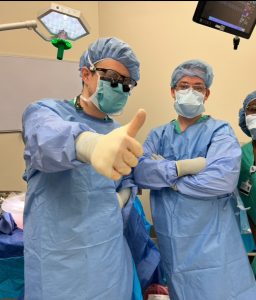
“Transplants don’t always happen during daylight hours, so it can be tough, but getting to be a steward of the gift that these people are giving really drew me in,” he said. “The true heroes are the donors, not necessarily the surgeons.”
In his time as a surgeon, many cases have made a lasting impression—but he’s often moved by the decision to donate, particularly from individuals with a checkered past.
“I remember one donor was an inmate who had done some terrible things,” Dr. Black shared. “But he donated his heart to a child. Being able to give the gift of life to a child… it’s just a really awesome thing. The ability to donate can be such a story of redemption for many people.”
Thanks to his training in Dallas, Dr. Black brought with him a specialized knowledge of NRP, a process that often means the difference between an organ being deemed unusable and one that goes on to save a life.
“There was a huge need for NRP in this region, and HonorBridge really wanted to invest in it,” he said. “So, I partnered with them, trained a few surgeons, and I’ve done about 60 cases now. Those are very likely 60 organs that wouldn’t have been placed otherwise.”
Though technically working on a case-by-case basis, Dr. Black jokes that he’s become “a procurement surgeon on the side,” simply because of how closely and frequently he works with HonorBridge.
“I really love the HonorBridge staff,” he said. “We’re all working in the middle of the night, but everyone is upbeat, and the focus is always on the donor. It’s a really good team camaraderie. I’ve been to the donor facility a handful of times and it’s an excellent facility. If I could do every case there, I’d be elated!”
The organ donation and transplant process is far from predictable. For every case that saves a life, some organs are unable to be recovered. These are labeled “Authorized Not Recovered (ANR),” meaning the organs are not transplantable despite the donation being authorized by the donor or their family. This not only causes a sense of secondary loss for the family but often discourages HonorBridge team members who try their very best to place every single organ.
As a transplant surgeon, Dr. Black offers a different perspective.
“It’s much better to strike out swinging than it is to strike out looking,” he said. “You’ve got to swing out at every one, you really do. And you never know when a liver you thought wouldn’t work goes on to save the life of a 30-year-old mom with four kids. That liver has this amazing ability to regenerate. Even if the organ doesn’t get placed, the act of trying gives many donor families closure. There are very tough weeks, but you’ve got to remember the patients you did save. They’re alive today. They’re making memories. That’s the ripple effect of what we do.”
From a 30,000-foot view, he says, the wins outweigh the losses.
“I don’t think success is defined by whether the organ got transplanted,” said Dr. Black. “Success is defined by the care you give to the donor. You are stewards of that organ, and whether an organ is placed or not, our job is to be a steward. We’re trying to give these donors the most honorable and dignified exit of this world, which is a huge honor to do.”
Despite advances in science and technology, and all the incredible success stories, Dr. Black knows there is still public skepticism around organ donation due to sensationalized headlines and negative social norms.
“Suddenly there’s this medical distrust that didn’t exist for my grandfather and for the majority of my father’s career, which saddens me,” he said. “I just wish people realized we’re doing transplant for the good of the donor and the recipient. There’s no ill intent; we want both parties to succeed. The transplant process is a beautiful process that can be amazing, but there’s still a lot of distrust, particularly in rural areas. The more we can educate, the better.”
And for those who are undecided about organ donation?
“I never tell my patients to do something I wouldn’t do, and I’m an organ donor,” he said. “You have the potential to save eight people and heal countless others. That’s such an amazing gift. The thing that makes us human is helping out other humans—that’s what separates us. It’s a beautiful thing if you can be an organ donor, and it can be a silver lining to a really tragic end.”
75 or more lives can be saved and healed by one organ, eye, and tissue donor. Sign up today!