For years, lung recipient Shannon had enjoyed a perfect bill of health. Her concerns were always about her mother’s well-being, not her own.
“I had gone my whole life and never had more than a common cold,” says Shannon. “When I was in my late 40s, my mom had been diagnosed with Chronic Obstructive Pulmonary Disease (COPD), a progressive lung disease that makes it difficult to breathe. In the last six months of her life, we found out that she did not have COPD, she had pulmonary fibrosis. We tried to get her listed for transplant and she wouldn’t have it. Two days later, we found out she had lung cancer.”
Shannon’s mother passed away when Shannon was 50, and soon after, she began to experience breathing difficulties of her own.
“I thought, I’m out of shape, I cannot breathe! I need to lose some weight,” says Shannon. “And it just continually got worse. In January of 2020, I got sick with the flu. I went to the hospital, and they said I had the Flu type A and pneumonia.”
Shannon’s symptoms lingered for six or seven months, with her doctor doing everything possible to treat the persistent pneumonia. Eventually, she was referred to a local lung specialist in Edgecombe County. After a couple of months of treatment, the specialist told her, “Shannon, I don’t think you have pneumonia.” He asked if he could refer her to someone else who might be able to help, and she readily agreed.
“He introduced me to Dr. Jason Lobo at UNC, and I will say, that’s the best man I’ve ever met in my life,” says Shannon. “He made me mad the first time I met him, but he saved my life.”
Dr. Lobo told her she had pulmonary fibrosis and asked if anyone in her family had a history of the disease. Shannon told him that her mother had been diagnosed with it, and he explained that she had likely inherited the condition. Then came the hardest news of all—she was already at the end stages of the disease and would need a lung transplant. Shannon was in disbelief.
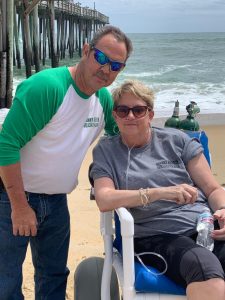
“I said, ‘what?!’ I didn’t even have time to process, I just went from pneumonia to a death sentence,” recalls Shannon. “I told him I wasn’t having the transplant, and I wouldn’t waste anymore of his time. My husband and I left his office that day and headed to the outer banks for our anniversary. My husband said, ‘I’m going to be here with you for whatever you decide. But I want you to be transplanted, because I’m not ready for you to die. And neither are your grandchildren.’ I went to the beach, and I laughed and cried, and I prayed. I asked God to help me make the right decision. The next morning, I got up and flung the curtains open and it was the most gorgeous sunrise I had ever seen in my life. All I could say was thank you. My husband woke up and said, ‘who are you thanking?’ I said, ‘I’m thanking God because He just gave me my answer. I’m getting transplanted.”
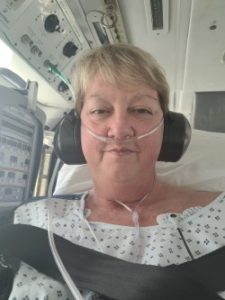
After the weekend ended, Shannon called Dr. Lobo and he laid out all the test requirements to get listed. She went home and scheduled every test except for the dental exam—which proved difficult during the height of Covid. By June 29, 2021, Shannon was at home, relying on 5–6 liters of oxygen and waiting for her upcoming dental appointment in July. That night, her worst lung—her right one—collapsed, and she was rushed to the hospital.
On July 5, she was flown to Chapel Hill, where Dr. Lobo was the first to greet her. He explained that she had reached end-stage lung disease and had only 2–3 weeks left to live without a transplant. When Shannon expressed doubt that lungs would become available in time, Dr. Lobo reassured her: “Leave that part up to me. You just keep praying for good results.”
The only thing holding up her official listing was the dental appointment, so the hospital arranged it. During the exam, they discovered infection pockets above every tooth, something not uncommon with her disease. The next morning, 27 teeth were extracted without anesthesia. Shannon felt it was a test of her faith. In the middle of the procedure, her husband received a call from Tina, her transplant coordinator—Shannon had officially been listed for transplant.
Just eight days later, Shannon received a call telling her that lungs were available. Shannon rushed to the hospital, but the surgeon told her the lungs were not viable. It was a “dry run.” Devastated, Shannon returned to her apartment, convinced that had been her one chance. A few days later, she received another call on July 24. “Shannon, we have a pair of lungs. They’re all for you.”
Shannon was transplanted the next day and discharged 14 days later. Since receiving her new lungs, her life has transformed in remarkable and positive ways.
“I wake up every morning and I thank God for letting these lungs serve me again,” she says. “I’ll get up, thank God for the day, put a smile on my face, and do the absolute best I can. If I’ve learned one thing since July 24, when I got that phone call, it’s that life’s short. You don’t know what’s coming tomorrow. Don’t spend your time being mad, sad, or angry. Love everything and everybody and tell them today, because you might not be here tomorrow. Make the best of every day.”
Following her transplant, Shannon wrote to her donor’s family and a year passed with no response. She convinced herself that maybe the family wasn’t ready, but she still felt the need to try again.
In her second letter, Shannon shared details of her life, including her two grandchildren, and expressed her desire to honor her donor on her transplant anniversary. She wanted to know more about the donor—man or woman, hobbies, favorite places—so she could meaningfully honor the life that saved her own.
A few weeks later, her donor’s family had responded. They were thrilled to know their mother’s organs had saved someone. Emails were exchanged back and forth, and eventually, her donor’s daughter, Stacey, asked if they could speak by phone.
Ten minutes later, she was on a three-way call with the donor’s children—a son and a daughter. Shannon’s donor’s name was Pam, and according to her kids, she had always wanted to be an organ donor.
“Stacey said it was a no-brainer to donate her mama’s organs,” says Shannon. “Pam would have wanted to be somebody’s hero and save somebody’s life. She was able to donate her lungs, liver, kidneys, pancreas, and corneas.”
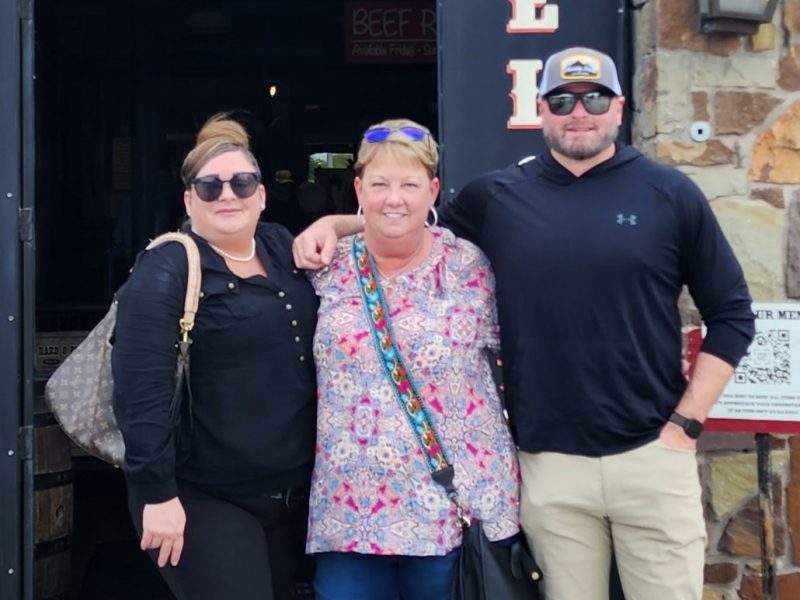
Stacey told Shannon she wanted to meet her, to hug her, and to physically feel her mother’s lungs as they rose and fell in Shannon’s chest. Shannon and her husband agreed and rented an RV to drive out to Texas.
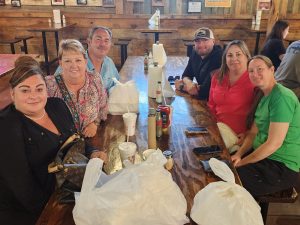
“We went to a BBQ place to meet,” recalls Shannon. “The son got there before the daughter, and we went next door to have a drink while waiting for Stacey. I saw her come in the door and she scanned the room, and she made eye contact with me. She screamed my name and came running across the restaurant. She hugged my neck and put a hand on my chest so she could feel me breathing. She said, ‘I hope this doesn’t make you uncomfortable, but this makes me so happy!’ They were the nicest people I’ve ever met in my life. They were all very thankful and grateful that their mom had helped save somebody else’s life.”
Today, the two families keep in close contact and have a unique and special bond. Since her transplant, Shannon has discovered that Pam not only gave her a set of working lungs, but also extreme hot flashes, a dripping nose, a love of steak, and an appreciation for heights.
“I no longer have a fear of heights,” laughs Shannon. “Pam loved to skydive. I used to hate steak, but now I can’t stop eating it. It’s the best thing I’ve ever had in my life! It’s just amazing to me.”
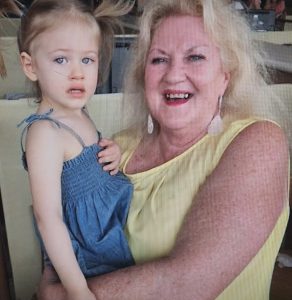
As a grateful recipient, Shannon encourages everyone to consider signing up as an organ, eye, and tissue donor.
“Just do it,” she says. “If there’s any thought of not doing it, change your mind! If you pass away, you’ve left your body anyway. You’ve been made new. Those organs that you have can save somebody’s life. Leave your organs here—Heaven doesn’t need them, but we do.”
More than 75 lives can be saved and healed by one organ, eye, and tissue donor. Sign up today!