
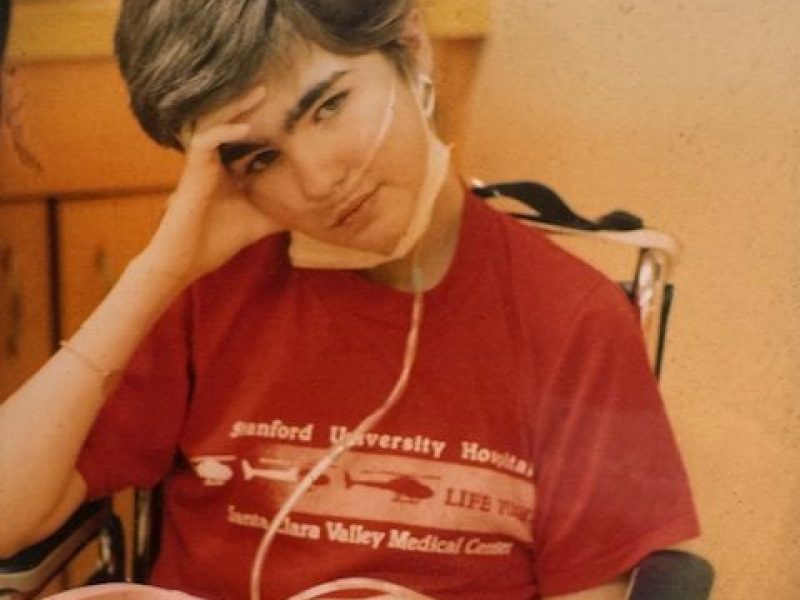
Some people spend a lifetime searching for a hero. Tim grew up with his.
“In 1988, my 10-year-old sister received a heart and lung transplant at Stanford University,” said Tim. “She was the first pediatric recipient at Stanford. When she was 12, her lungs began to fail, and my dad was preparing to become the first living lung donor. Then, the day before surgery, we got the call that a donor had become available. She received a second heart-lung transplant. She was the strongest and bravest person I’ve ever known.”
Kaycee lived another 10 years before passing away at age 22 from kidney failure. While her life was far too short, the gift of organ donation gave her and her family 12 more years together.
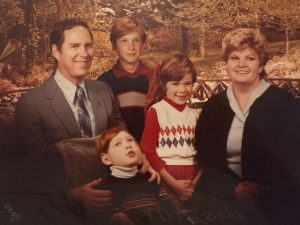
It can be easy to forget the impact that donation and transplantation can have on everyone, not just the recipients. Despite the fact that his sister’s first transplant happened almost 40 years ago, Tim is still influenced by his sister’s journey today.
Over the years, he has honored Kaycee’s legacy by writing two songs. One, “Breath That Didn’t,” reflects on her lifelong resilience.
“She kept breathing when it hurt, kept fighting through the night. Showed the world what courage is and what it means to fight.”
His second song, “Two Families,” pays tribute to the connection between donor families and transplant recipients, capturing how one family’s loss can become another family’s hope.
“Two families, worlds apart. One holdin’ on, one broken heart. One prayin’ for a little more time, one losin’ everything in a night. Somewhere in the darkest pain, a light breaks through the rain, a goodbye becomes a lifeline. Two families…forever intertwined.”
Kaycee’s health problems began when she was only six years old. Simply walking across a room left her out of breath, forcing her to stop and rest. Concerned, her mother brought it up during an annual checkup. Initially, the doctor gave her a clean bill of health, but after hearing about her breathing difficulties, he asked Kaycee to jog in place. She became winded after only about 20 seconds. When the doctor listened to her heart with a stethoscope, he asked the family to meet him at the medical clinic the following morning.
She was eventually diagnosed with primary pulmonary hypertension, a rare condition in which the blood vessels in the lungs become narrowed, forcing the heart to work much harder to pump blood through them. At the time, the only effective treatment was a heart-lung transplant.
“For the next four years, she lived a fairly normal life,” said Tim. “I was three years older than she was, and we fought just like every brother and sister. She was getting a bit weaker as time went on, until Stanford University put her on the transplant list.”
Despite the decades that have passed, Tim still remembers the first call that changed everything.
“It was later in the evening, and we were getting ready to sit down for dinner,” he recalled. “The hospital sent us a message on our pager to call a number. We did, and they told us they had a donor.”
In an instant, the family’s quiet evening turned into a race to save Kaycee’s life.
“All heck broke loose,” Tim said. “We gathered everything we could think of and jumped in the car. We lived on a small farm, so we drove about 20 miles to Lincoln, California, where the Life Flight helicopter was waiting. My mom went with Kaycee on the helicopter, and my dad, my brother and I continued the trip in our van. We met them at Stanford that night.”
The transplant transformed Kaycee’s life almost immediately.
“We stayed at the Ronald McDonald House for several weeks after she was discharged from the hospital,” Tim said. “You could see such an incredible transformation. She could get up, walk down the street, and not have to stop to catch her breath. Before long, she was almost outrunning me. You could tell there was a huge difference.”
Unfortunately, just two years later, Kaycee faced another devastating setback. For reasons doctors couldn’t explain, her transplanted lungs began to fail. With time running out, both of her parents underwent testing to see if they could donate a portion of their lungs in what would have been a groundbreaking procedure. Tim’s father was found to be a match.
“At the time, it had never been done before, and Stanford knew it would be a media frenzy,” Tim said. “So we didn’t tell anybody. We kept it completely under our hats.”

His father was scheduled to travel to Stanford the following day to donate two lobes of his lungs. Before leaving, he gathered with the staff at the church where he worked to pray for Kaycee and the surgery ahead.
“They were in the middle of praying about the whole situation when the phone rang,” Tim recalled. “There was a donor available.”
Once again, a family’s decision to say “yes” to organ donation changed the course of Kaycee’s life. Following her second transplant, the family moved from California to a small farm in Oklahoma where Kaycee was homeschooled and able to enjoy life with her family. Today, Tim continues to advocate for donation and honor his sister’s life in every way possible.
“I want people to understand the impact of donation,” said Tim. “Even if it’s not a cure, it can give them many more years of normalcy. I’ll always remember what a great person my sister was, and how tough she was. Someone lost their loved one, but mine got to live a little longer. I can only say thank you for that.”
75 or more lives can be saved and healed by one organ, eye, and tissue donor. Sign up today!