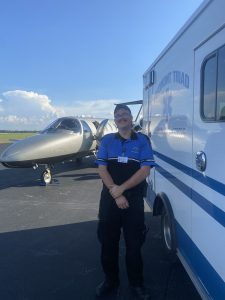
In honor of National Emergency Medical Services (EMS) Week, we did a Q&A with Eric Weaver, an Advanced EMT with Piedmont Triad Ambulance Rescue. Professionals like Eric help make organ donation and transplantation possible behind the scenes, playing a unique role that many donor families and recipients aren’t aware of.
What is Piedmont Triad Ambulance Rescue (PTAR)?
We’re a private organization that provides a mix of scheduled transport and 911 response, often serving as backup for Guilford, Randolph, and Davidson counties. Our crews operate both basic EMT ambulances and ALS AEMT units—ambulances staffed with an Advanced EMT who can deliver a higher level of care, depending on the situation and where we’re needed.
In what capacity does Piedmont Triad Ambulance Rescue work with HonorBridge?
We transport HonorBridge’s transplant teams from the airport over to Moses Cone or High Point Regional, depending on the case. I remember when I first started, you’d hear about a flight call maybe once a week. Now, it’s more like once every couple of weeks or once a month. Some of that has changed because transplant coordinators may not always need a full ambulance, since an SUV can easily pick up a smaller team. But when we are called, it’s a unique and important part of what we do.
What does a typical transplant transport look like—from the moment the call comes in?
My shift is usually 8 to 8, so we come in around 7:30 a.m., check everything, and get ready. We work with both our in-house dispatch and county 911, so we check in with both to see where we’re needed.
When a transplant call comes in, it’s different from anything else we do. We usually get a heads-up ahead of time because it’s not a typical call, and there are specific instructions, like where to go at the airport and how to access the area.
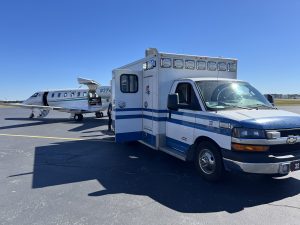
We’ll head to the Piedmont Triangle International Airport, get the aircraft’s tail number, and wait. Once the team arrives, we’re brought out onto the tarmac, where we load the surgeons and any equipment they have. That can vary. A recent call involved transporting a heart in a self-contained unit that keeps it pumping.
From there, we transport the team to the hospital, which is usually Moses Cone or High Point Regional. We drop them off at the OR, and wait. We’re required to stay on-site, which can mean waiting 5–7 hours while the procurement takes place. Once they’re ready, we bring the team and the organ back to the airport.
Most of the time, it’s non-emergency, meaning no lights or sirens. Occasionally, timing becomes critical, and we’ll switch to emergency transport. It’s an anomaly of a call, and most of us really look forward to it because it’s so unique.
What makes organ transport different from a typical medical transport?
The gravity of what we’re carrying. On one call, we were driving back to the airport with a heart onboard when someone cut us off and nearly caused an accident. It really hit me afterward that there was a doctor with decades of experience in the back, an organ that was going to save someone’s life, and hundreds of thousands of dollars worth of equipment. That weight stays with you; it’s not just another transport.
What’s something most people don’t realize about the transportation side of organ donation?
The sheer amount of logistics. Even from our side, there are so many moving parts—dispatch, transplant coordinators, surgeons, hospital staff. Everything has to line up perfectly.
And that’s just one piece of it. When you think about the full process—honoring a donor’s wishes, supporting the family, transporting the organ, and then transplanting it into a recipient, it’s an incredible amount of coordination and effort.
What would you want donor families or recipients to know about the care and respect that goes into every transport?
In addition to the crazy amount of logistics that goes into every transport, there’s also an incredible amount of care and respect for the family and their decision to donate. While it’s rare, I once saw the mother of an organ donor watch us carry his lungs in a cooler. She was able to personally see the impact that her son had. It was an incredible thing to witness.
How has being part of the donation and transplant process shaped your perspective on organ donation?
It hasn’t necessarily changed my perspective, but it’s definitely reinforced it. I already believed in organ donation, and this work has only strengthened that. I think there can be a stigma depending on who you talk to, but I don’t think there should be. It’s something that truly does an incredible amount of good.
I’m a registered organ donor myself. Once I’ve passed, I don’t need it—that’s my perspective. It’s simple, but it’s true. If it can further somebody else’s life, there’s no reason not to.
75 or more lives can be saved and healed by one organ, eye, and tissue donor. Sign up today!