In the world of organ, eye, and tissue donation, it’s easy to describe Family Support Coordinators (FSCs) as the professionals who meet with families, often in hospital settings, to discuss the possibility of donation. But that definition overlooks the most important part of their role: support. It’s right there in their title. Simply put, family support coordinators are there to support families, whether they choose to donate or not.
Let’s talk about it.
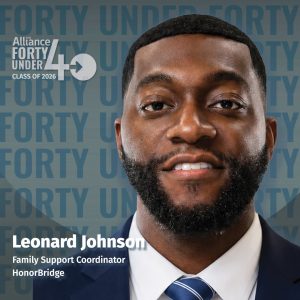
Leonard Johnson has served as a Family Support Coordinator at HonorBridge for 15 years and was recently named to the “40 Under 40” list by The Organ Donation and Transplantation Alliance in recognition of his outstanding work. His efforts have contributed to more than 415 donor approaches, 314 authorizations, 642 transplanted organs, and 169 research donations.
But that’s not how Leonard defines success.
“For me, success is giving each and every family the opportunity to say yes to donation,” said Leonard. “I truly take it as an honor and a privilege to sit down with families while they are experiencing one of the hardest days of their lives. Any family I come in contact with, I make it very clear that I’m not only a representative of HonorBridge—I look at them as part of my family, too.”
And, as Leonard is well aware, many families say no.
“Honestly, growing up, I was educated by my community to say no to donation,” said Leonard. “Coming from a town like Rocky Mount, North Carolina, there was definitely a lot of medical mistrust. This mistrust was passed down from generation to generation. It wasn’t until later, when I got to college and educated myself, that I changed my decision and became a registered donor.”
That lived experience has given him a better understanding of the concerns some families bring into the conversation. Today, that perspective helps him meet families where they are.
“I don’t focus on getting the ‘yes,’ he said. “I’m more focused on having an effective, compassionate conversation with every family.”
Speaking with devastated families isn’t for everyone, and when Leonard first started in this work, his business marketing degree didn’t fully prepare him for what he would encounter. It was his experience working directly with families that shaped him.
“Once I graduated from East Carolina University, I transitioned into a full-time position in the mental health field,” said Leonard. “I stayed in that field for about six years, working my way up until I became what they call a Qualified Professional. I had a full caseload, working with different families during different crises. That’s where I got my background working in the medical field, handling different crises, being a first responder in that sense, and taking calls.”
From there, Leonard opened an indoor recreational center in Greenville, North Carolina, focused on providing a safe environment for children with autism and a welcoming space for families to bring their children. Shortly after, he accepted a position at HonorBridge. His deep love and commitment to families never went away; it simply evolved into supporting families through their donation decision.
“The families I come into contact with are the ones who keep me going every day,” said Leonard. “If I can help them feel supported, respected, and cared for, regardless of their decision, then I feel like I’ve done a great job. When families do choose donation, I hope they’re able to see the good that comes from it. But my biggest goal in every conversation is simply to make sure they feel supported.”
For Leonard, being with families in that moment doesn’t mean simply sitting with them until they give him a yes or a no—it means sitting in the fire with them as they grieve. As a father of three, one case has stayed with him more than any other.
“It was a pediatric case involving a child who was sitting in the living room watching TV when a stray bullet came through and struck him in the head,” said Leonard. “When I sat down with the patient’s mother and father to speak with them about the opportunity for organ donation, I could see the hurt and the grief on their faces. Being a parent myself and seeing them make that decision was one of the biggest and bravest things I’ve ever witnessed. I’m not sure I would have been able to make that same decision, even though this is what I do day in and day out. I was sitting in front of those heroes, the parents themselves. Because of their decision, many lives were saved, including the lives of many children. That’s one case that always stays with me.”
As an African American man, Leonard is passionate about making a difference in his own community. During his time as a Family Support Coordinator, HonorBridge identified a significant gap in authorization rates among minority families compared to other demographic groups. Rather than accept those numbers, Leonard saw an opportunity to better understand the barriers and improve the conversations taking place.
“I’m aware that minorities make up a large portion of those waiting for kidney transplants, especially here in North Carolina,” said Leonard. “If we can improve those conversations and increase donation, we can hopefully lower the number of people waiting for a transplant. We took a deep dive into the data and used that information to determine what we could do to improve our conversations with minority families. After focusing on this for over a year and being more intentional, we not only saw an increase among minority families, but we also saw authorization rates increase across the board. Being a minority myself, I took a lot of pride in being part of that work because I personally saw the gap. Not only did we recognize it, but we were able to do something about it.”
That work reinforced Leonard’s belief that meaningful change starts by listening.
“Sometimes it’s hard for families to even hear what you have to say because they’re still worried about everything they’ll have to deal with once they leave the hospital,” said Leonard. “If you slow the process down and address their needs first, then they can actually hear you when you begin talking about organ and tissue donation. Many of these families are dealing with transportation issues, funeral costs, complicated family dynamics, and other challenges that affect their ability to even be present in those conversations. You’re not just there asking for something, you are also serving as their advocate. Sometimes families simply need someone to be their voice.”
Whether a family chooses donation or not, Leonard hopes they leave knowing someone stood beside them. And when they do choose to say yes, he knows that decision can create a legacy far greater than anyone could imagine.
“Every donor becomes someone’s hero, and every recipient deserves a second chance,” said Leonard. “I’ve learned that while we can’t change the loss of a family member, we can always create meaning through organ and tissue donation. Because of that, every family has the opportunity to leave a legacy that lives on.”