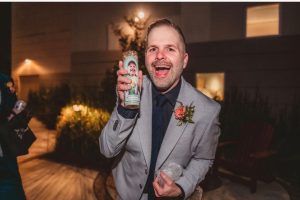
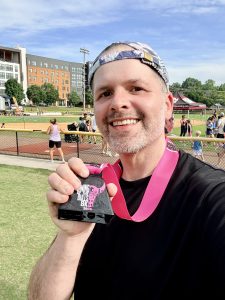
There are plenty of words that could be used to describe Joel Baucom. Dedicated, approachable, hardworking, funny. But after 15 years at HonorBridge and countless relationships built along the way, the best way to describe him is simple—he’s a people person. It’s a quality that has shaped the way he leads and will serve him well in his new role as Chief Operating Officer (COO).
While attending Appalachian State University, Joel became fascinated by the growing field of health psychology, using psychology and cognitive behavioral techniques to improve health outcomes. With a strong faith background, however, Joel was particularly interested in how people could utilize their faith as a mode of healing.
“I read studies about people who felt prayed for and seemed to recover faster,” said Joel. “The science behind that is probably related to reduced stress and feeling cared for, but it fascinated me.”
When Joel enrolled in divinity school at Campbell University, his goal was to become a hospital chaplain. While there, he completed Clinical Pastoral Education (CPE), including both an internship and later a residency at WakeMed in Raleigh. It was during his time working in the neuro intensive care unit that he was first introduced to organ donation.
“I worked closely with several Family Support Coordinators (FSCs) there,” said Joel. “I had become involved in conversations with care teams and families about withdrawing life-sustaining therapies and watching families make incredibly brave decisions. The move to HonorBridge felt very natural because I came into this work understanding what those moments look like from a family’s perspective, and that has always informed me.”
Joel’s first role at HonorBridge was as a Family Support Coordinator. While he did not come into the position with extensive personal experience with death, he drew on his background in hospital settings, along with his faith and a natural ability to connect with people.
“From day one, I’ve just been in awe of our donor families,” said Joel. “I knew the kinds of questions people were grappling with, and I would try to put myself in their position. I would think about how long they had been sitting at a bedside waiting for a miracle to occur, or for the trajectory of their loved one’s condition to change so they could come home and life could get back to normal. Then, for that not to happen, and for them to sit in front of a stranger and hear about donation and still have the ability to think beyond that moment of loss to the hope it could provide someone else, I think that is remarkable. I’ve never lost sight of that.”
Since his time as a Family Support Coordinator, Joel has risen through the ranks at HonorBridge, serving in a variety of leadership roles including Manager of Family Services, Director of Organ Operations, Director of Partner Engagement, and most recently, COO. Through it all, the lessons he learned at the bedside with families have stayed with him.
“We should think of it as an honor to do this work because we create an opportunity for a family that is going to experience death whether we are there or not,” he said. “But if we are there, something transformative could happen. Donation is such a beautiful, unique opportunity for a little bit of meaning to emerge in an unexpected place—in a place that is otherwise very hard.”
As a first-generation college student, Joel is particularly proud of achieving the role of COO, but he’s just as proud of the path he took to get there and the perspective it’s given him.
“Growing up in a big family in rural North Carolina, I learned how to navigate different perspectives, treat people with kindness, and work hard,” said Joel. “That’s influenced how I lead and how I build relationships. I’m proud of the work I’ve done, but even more grateful for the foundation my family gave me.”
When it comes to leadership style, Joel lets his people-centered perspective guide him. One of his favorite quotes is from Chinese philosopher Lao Tzu:
“Go to the people. Learn from them. Live with them. Love them. Start with what they know. Build with what they have. But the best of leaders when the job is done, when the task is accomplished, the people will all say we have done it ourselves.”
More than anyone, Joel understands how hard and emotional this work can be. Beautiful things can happen through donation, but the story almost always begins with loss. To those considering a career in donation, Joel encourages them to ask themselves one question: Is it worth your life to save a life?
“This job does take a lot out of you,” said Joel. “It impacts our families and our time. We work weird hours. I get called at four in the morning to answer questions, and everyone in my house has to deal with that, too. But this work goes beyond a job or an occupation and is really a vocation. The Latin root is vocare, meaning ‘to call.’ In my divinity school years, we would have called this a calling. It’s not for everyone, but what I would say to the HonorBridge team is this: if you’re here and you’re doing this work and you’re enjoying it, then you have found your calling. And that’s a beautiful place to be.”
Outside of work, Joel makes a point to fully enjoy and make the most of his free time. He enjoys hiking, traveling, and improv comedy, and jokes that he “puts the COO in cool.”
But more than anything, he never loses sight of what this work means.
“If we show up and do our work effectively, someone will not die today,” said Joel. “That’s what’s at stake. We have to imagine that our mom, our daughter, our brother, or someone we love is on the waitlist. If that were the case, I’d be running the streets. I’d be putting up billboard signs. Most people can’t do that, so that becomes our task. That’s our duty.”