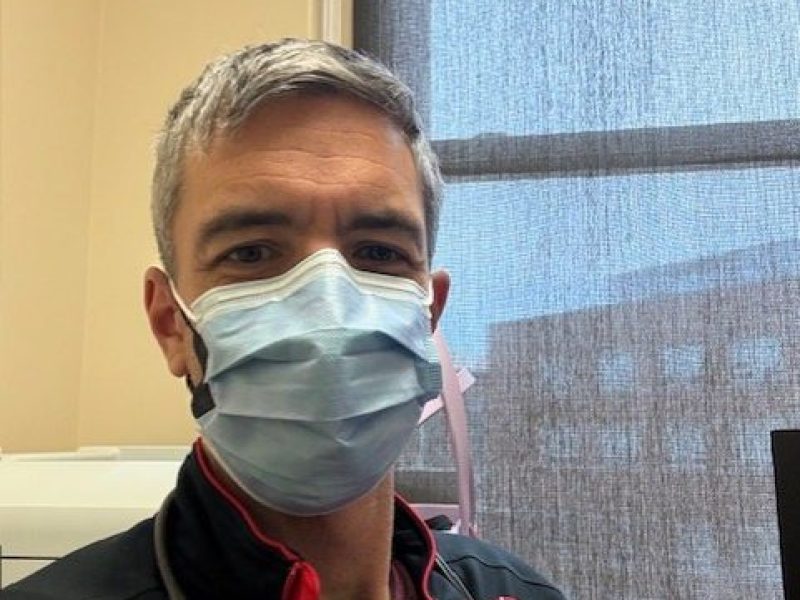
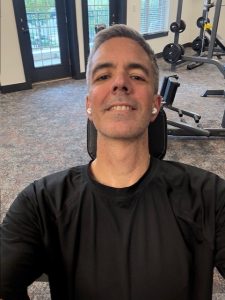
Standing at 6’6”, Eric Gill is a friendly, self-proclaimed “hugger” in his 40s—and at first glance, you’d never suspect that his journey to becoming a palliative care nurse practitioner was shaped by years of personal health struggles.
“I received a liver transplant on June 12, 2024. I was 43 years old,” says Eric. “As for the exact cause of my liver failure, they still don’t know, even after a whole liver pathology. The best guess is maybe a viral infection in childhood.”
When Eric had his tonsils removed in 5th grade, routine pre-op labs raised a few eyebrows, prompting a follow-up bleeding time test the next day. At the time, it was treated as a curiosity, and no one seemed particularly concerned.
Years later, in high school, Eric was preparing for a hospital internship and had to complete a new round of labs. Again, his platelet count came back low. Doctors ran some tests and referred him to a pediatric hematologist, and he spent the next three to four months undergoing evaluations. In the end, the doctors concluded it was likely a childhood condition he’d outgrow. With little more than a “good luck,” Eric was sent on his way.
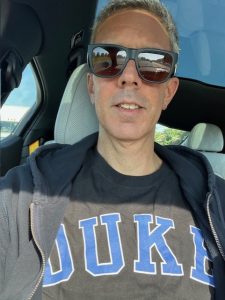
“I went to college and went to nursing school, and then I moved to NC,” he says. “When I was probably about 25, I had a bunch of abdominal pain, so I went to the hospital, and they ended up admitting me for like 4 or 5 days and brought in a hematologist. They eventually sent me to Duke’s hepatology and set me up for a liver biopsy.”
Eric says he’ll never forget the moment he received the call from hepatology on his way to Costco. His test results were in, and his liver was completely scarred. At just 25 years old, he had full-blown cirrhosis.
This call kick-started almost two decades of endoscopies, lab work, MRIs, and CT scans.
“Over the years I just went through the motions,” he says. “Being in healthcare, I made sure I took care of myself. I went through all of that for about 18 years before I got listed. Things progressed, and over time, my labs slowly increased. I had six or seven endoscopies over the course of two years. They placed over 20 esophageal bands. My spleen got absolutely gargantuan. In January before the transplant, I literally looked about six months pregnant in my CT scan. I started having lots of edema and it got to the point where I didn’t like to wear shorts or ankle socks because I had these swollen, puffy ankles.”
Eric remembers being constantly short of breath, and climbing stairs became nearly impossible. This was during the height of Covid, and as a hospital employee, he was wearing a mask every day, which only made things worse. He would get winded just walking down a hallway. He was referred to a transplant center for evaluation more than once but was initially denied for listing—twice—because doctors believed he was still too healthy.
It wasn’t until his oxygen saturation began to drop that the transplant team reconsidered. This time, Eric was officially listed for transplant in March 2023. One year and three months later, he received the call that saved his life. After previously experiencing a dry run, he was hesitant to believe it was real.
“When I got what ended up being my transplant call, it was like 3 p.m.,” recalls Eric. “I didn’t even call my partner at work, because I didn’t want to get everyone’s hopes up. They said they would call us back by 7 p.m., but that time came and went. We stayed up way past our bedtime. My partner, Patrick, was actually asleep, but I didn’t sleep the whole night, as you can imagine. I finally fell asleep around 5 or 6 in the morning, and then they called me around 7 a.m. and said, ‘Hey, everything looks good! If you’re not doing anything, do you want to come and get a new liver?’ I joked with her and said, ‘I was planning on getting lunch with my best friend, but I guess we can postpone it!’”
His emotions all over the place, Eric checked in for surgery and was brought into pre-op.
“Your mental state is just weird,” he says. “You’re on an emotional rollercoaster—you’re happy, but you’re scared for your life. Either this will go well, or it won’t. I’ll either wake up with a new liver, or I won’t.”
His partner and aunt were there with him, and his best friend was on the way. When he texted his brother with the news, he kept it light, in true Eric fashion. “ThunderCats are go!”
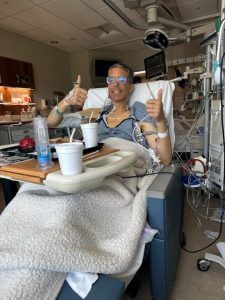
Eric’s surgery took seven hours, and everything went well. During recovery, he was determined to follow his doctor’s orders to the letter.
“From a healthcare perspective, I know what happens to people when you linger in the bed and you don’t do what you’re supposed to,” he says. “They put a walker in front of me, and I was like, let’s go!”
Because transplant patients need someone with them 24/7 during the first month, and his partner had to work, Eric’s aunt—now affectionately known as “Saint Margie”—stepped in. She prepared meals, washed dishes, and drove Eric to Duke several times a week for his early follow-up appointments. “She’s definitely earned her place in heaven,” laughs Eric.
During his recovery, Eric chose to write his donor’s family a letter and plans to send it soon.
“I work in palliative medicine, and I’ve been there for so many organ donation conversations and so many honor walks,” said Eric. “I’ve seen people in their hardest moments. In writing my letter, I cannot change their grief and loss, but if there’s at least a glimmer of light to lessen the darkness, then that’s a benefit. I hope that they understand the difference their loved one made, and that it helps them in their grief journey. I’d love to meet them one day. I’m a hugger, so the first thing I’ll do is give them a hug.”
Eric says his personal experience with organ failure and transplant has made him a much better nurse practitioner. While he was already skilled at having difficult conversations and supporting patients facing serious illnesses, living through a life-threatening condition has given him a deeper, more personal understanding of what his patients endure.
“We work with patients who have serious illnesses,” says Eric. “Their life is going in and out of the hospital. That’s a hard place to be, and I’ve been there. In the hospital, you lose all control. You do what they tell you to do, you eat when they tell you to eat, you get up when they tell you to get up. That is incredibly frustrating when you have a complete loss of control. When they feel that way, I can tell them that I understand—it’s just a ‘sorry, I get it,’ I’ve actually been there. I do understand. I’ll often share my story with them to let them know it’s not just platitudes. That’s probably the biggest impact in my profession—empathy.”
As a healthcare professional, Eric has always known that organ donation is lifesaving—but until he became a recipient himself, that understanding felt abstract. “It saves lives” is a powerful phrase, he says, but it becomes truly real when people meet someone whose life has actually been saved.
“I think it’s important to reach out and touch somebody who has actually benefited from this,” he said. “It puts into context and reality something that’s often very nebulous. I think it’s harder for people to come to terms with organ donation because they don’t truly understand what it can do. That first conversation about organ donation can be hard, and often we’re involved as a palliative care team. I’ll sometimes share my life story with them and kind of help them understand that there is a real person out there who has hopes and dreams and desperately wants to live. If they’re having the conversation about organ donation, they’ve already worked as hard as they can to save your loved one’s life. We don’t have that conversation when you’re just pretty sick and we’re not sure if you’re going to make it.”
As Eric reflects on his transplant journey, he has plenty of experience to offer, both as an NP and as a recipient.
“Follow directions. Take care of yourself—physically, nutritionally, but also mentally and emotionally. Being on the transplant list is a form of grief. You’re grieving the loss of normalcy, of health, and sometimes even facing anticipatory grief about the possibility of losing your life,” he says. “It’s okay to cry, to feel frustrated or angry—those are all valid emotions. Just don’t try to do it alone. If you need counseling, get it. I did, and it helped.”
If he could speak to his donor directly, Eric says the first thing he would say would be “thank you.”
“Thank you for me, thank you on behalf of my family and my friends, and thank you for all the other people whose lives may be changed,” says Eric. “Our actions are like ripples in a pond; you don’t know the extent the effects of your actions will have. There might be a patient that I touch, and their life ends up dramatically changed or even saved because of the interaction they had with me. That would be an effect of your sacrifice. So, thank you for the people I don’t know who to thank you on behalf of.”
Today, Eric continues to find joy in the “little” things, like being able to wear shorts and flip flops without feeling self-conscious and having the energy to fully enjoy time with friends and family. At work, Eric finds even more meaning in helping patients live as well as they can, for however long they have.
“While what I do may not treat and cure someone’s illness, I help them come to terms and figure out how to live the best they can with the best quality that they can, despite their illness,” says Eric. “If I can help them enjoy their time, then I’ve made a good impact on somebody and changed a life.”
Eric also encourages everyone, regardless of their health status, to have conversations about advance directives and end-of-life decisions.
“Life is dramatically and unfortunately unpredictable,” says Eric. “Have those conversations and have your documents ready so your family knows what you want. Even if you’re not an organ donation candidate, they might still be able to use corneal tissue or skin grafts for cancer patients and burn survivors. Have those conversations. Make your wishes known, as uncomfortable as the conversation may be, including tissue and organ donation.”
More than 75 lives can be saved and healed by one organ, eye, and tissue donor. Sign up today!