On August 11, 2022, Jenny’s life changed forever when she underwent a lifesaving liver transplant at only 49 years old.
“I really just started to feel bad, probably around November of 2021, and did not know what was wrong. I could not hold any food down; I was just sick and tired. That progressed all the way through the beginning of 2022 before I finally went to the doctor. I’d just figured I was out of shape, but it just got worse and worse. I was rapidly losing weight, without intending to. I had every test you can imagine, even going into the hospital for three days at one point, and still no one could tell me what was the matter.”
Jenny kept getting sicker, and was eventually confined to bed every day, too weak to do much more than try to work from under the covers. Even then, she could only manage about three hours before overwhelming exhaustion set in. Her vision began to fade; everything around her looked dim. She walked through her house thinking she needed to replace the lightbulbs, not realizing it was jaundice clouding her eyes and that her liver was failing.
“One day I just didn’t wake up one morning, and my husband happened to come upstairs,” Jenny recalled. “I was unconscious. He picked me up and carried me down to the car and took me to the hospital. When I was there, they told him that my ammonia levels were sky high and that if I had been left there much longer, I would not have lived.”
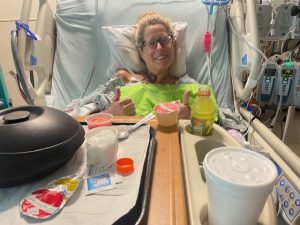
Eventually, Jenny was transferred to Duke University Hospital. She wasn’t conscious for most of what happened next, and even during her brief periods of awareness, her mind was clouded by the effects of severe ammonia poisoning. After being diagnosed with NASH, a severe form of nonalcoholic fatty liver disease, doctors determined she would need a liver transplant. Because of the severity of her condition, Jenny was quickly placed at the top of the list.
“I remember being told, ‘We found a liver for you,’” she said. “But I was so sick that I wasn’t even fully aware of what was happening.”
As surgeons began the transplant, they discovered a life-threatening complication.
“When they got me opened up, the doctor came out about 30 min after they started and told my husband and brother that my colon was mostly dead and they couldn’t put a healthy organ into me,” she said. “They told them we’re just going to make me comfortable and that’s probably going to be it. But then, not 25 minutes later, the surgeon came back and said ‘we’ve decided we’re going to try and repair her colon and give her the liver transplant at the same time, because if we don’t do it, she has zero chance, but if we do it, she has a 25% chance.’ Of course, my family was like, well we’ll take 25% over 0%! Ultimately, it ended up being a good gamble because here I am.”
Jenny’s recovery was slow, and she spent months in inpatient rehab before finally returning home on October 28, 2022. From there, her focus shifted to regaining strength, both physically and emotionally.
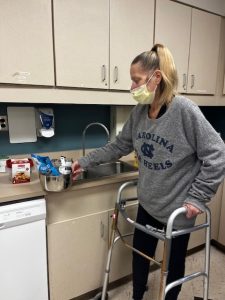
By July 2023, nearly a year after her initial collapse, Jenny returned to her job as a lawyer part-time. Her journey back to “normal” life was gradual. “It felt like ten years had passed,” she said. “But by the end of 2023, I could work a full day and still feel like myself.”
Emotionally and mentally, Jenny has emerged from her experience with a new perspective on life.
“I used to be a terrible worrywart. Now I realize how many of the things I stressed about were completely inconsequential,” she shared. “For so long, I had to put all my energy into just surviving. That shift made me more at peace with myself and the world around me.”
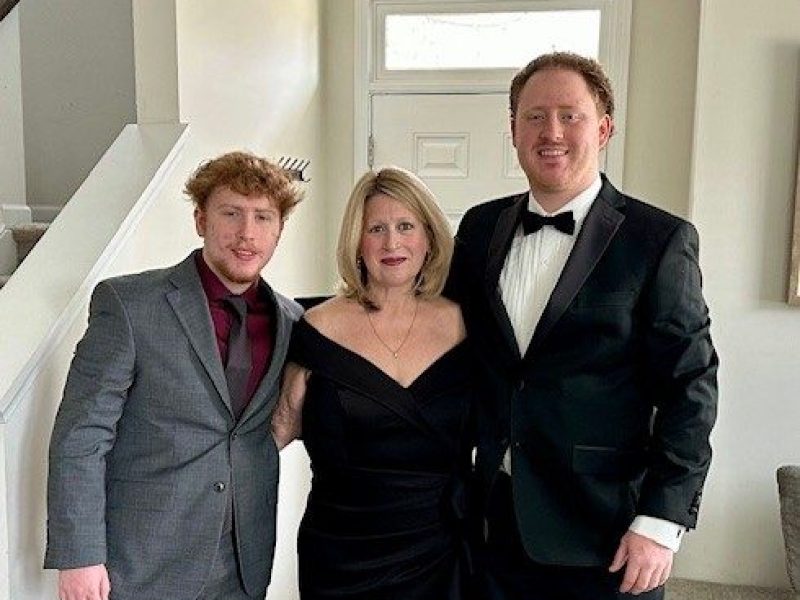
Since her transplant, Jenny has celebrated some of the most meaningful milestones a mother can experience. She watched her youngest son graduate from high school, and in March 2025, she stood proudly at her older son’s wedding. “I got to wear a pretty dress and help them celebrate,” she said with a smile. “Those moments are everything.”
She often reflects on her first Christmas post-transplant, cuddled on the couch in pajamas with her husband, feeling the immense weight of what could have been.
“It could’ve been their first Christmas without me,” she said. “Instead, I was here. But I also know it was my donor family’s first Christmas without their loved one. That’s something I never forget.”
Jenny did write a letter to her donor’s family, expressing her gratitude and compassion. She hasn’t heard back, and she understands she may never.
“It was helpful just to write it,” she said. “Someday, I’d love to know who they were. But I also understand that’s a big step for them. I was only 49 when I received my transplant—I felt like I had a whole life still left to live. My own mother died when she was 47, and even today I think of everything that she’s missed. Their loved one gave me a whole new life. Not just the same old one I had, I got a whole new one. I’m a different person. I feel better. I look better. I think my family appreciates me more, and I appreciate everything else more.”
Thanks to a stranger’s selfless decision, Jenny gets to wake up every day with a new lease on life.

“It is the most incredible gift that you can give someone,” she said. “You’re not just giving someone their life back; you’re also giving their children a parent back or their parents a child back. As hard as it is to say, you’re not going to use it anymore. Your time with needing that body is over. Nothing useful will be done with it at this point, but what you can do to change another person’s life entirely is just exponential. You can’t put it into words.”
75 or more lives can be saved and healed by one organ, eye, and tissue donor. Sign up today!